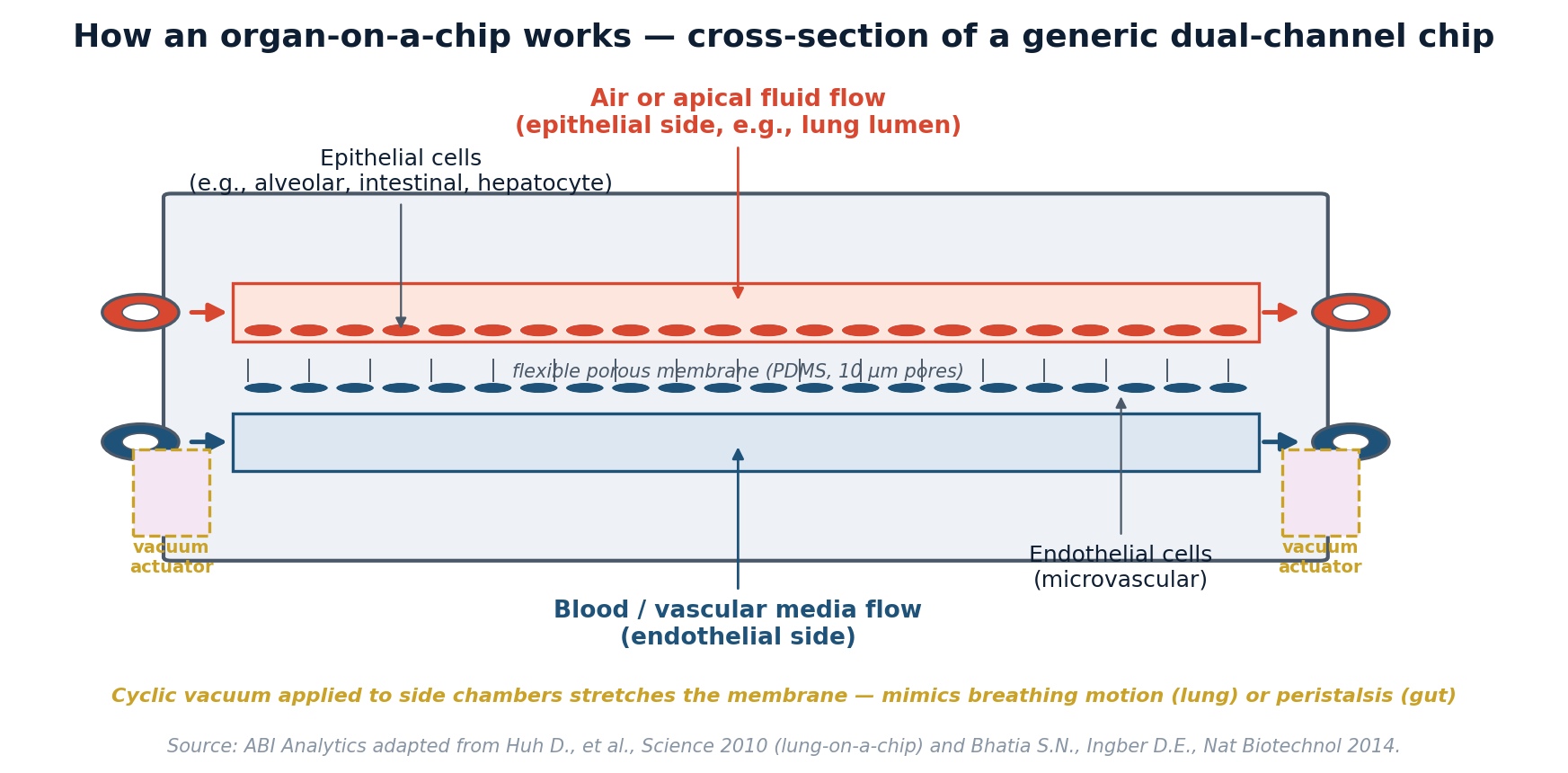
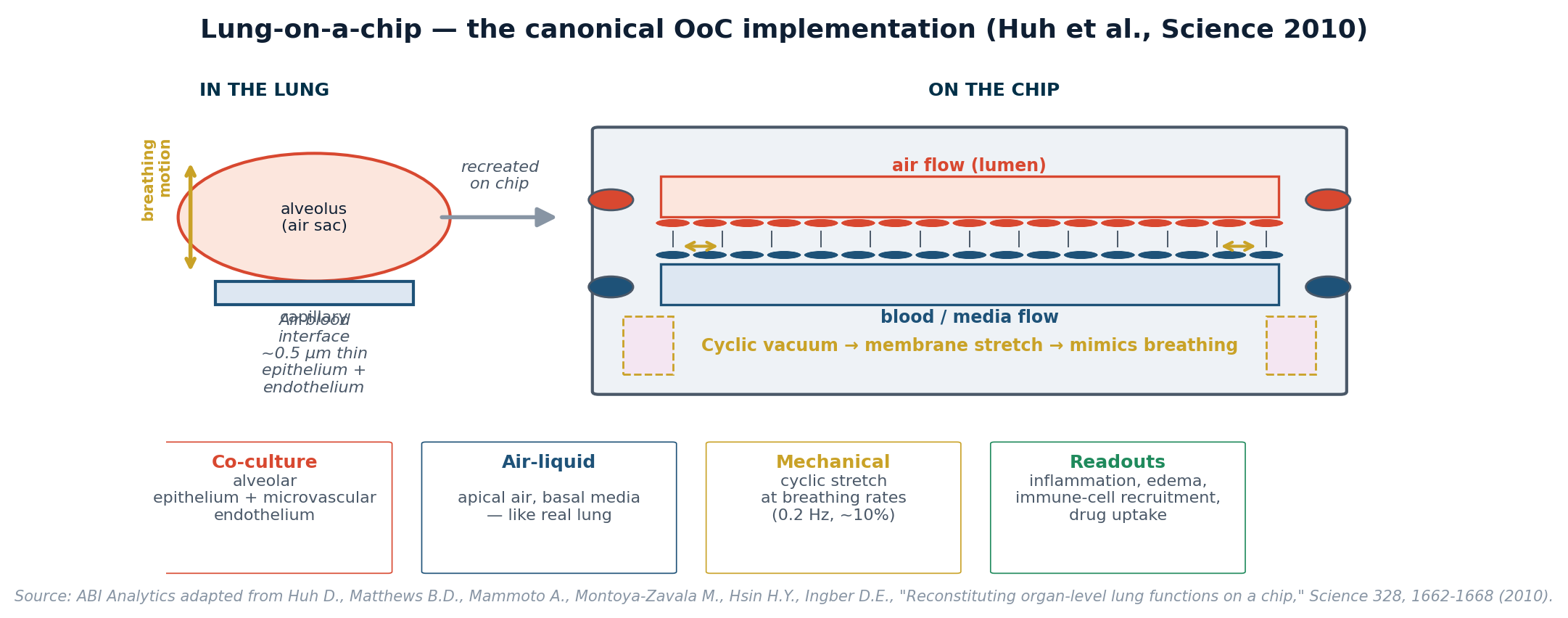
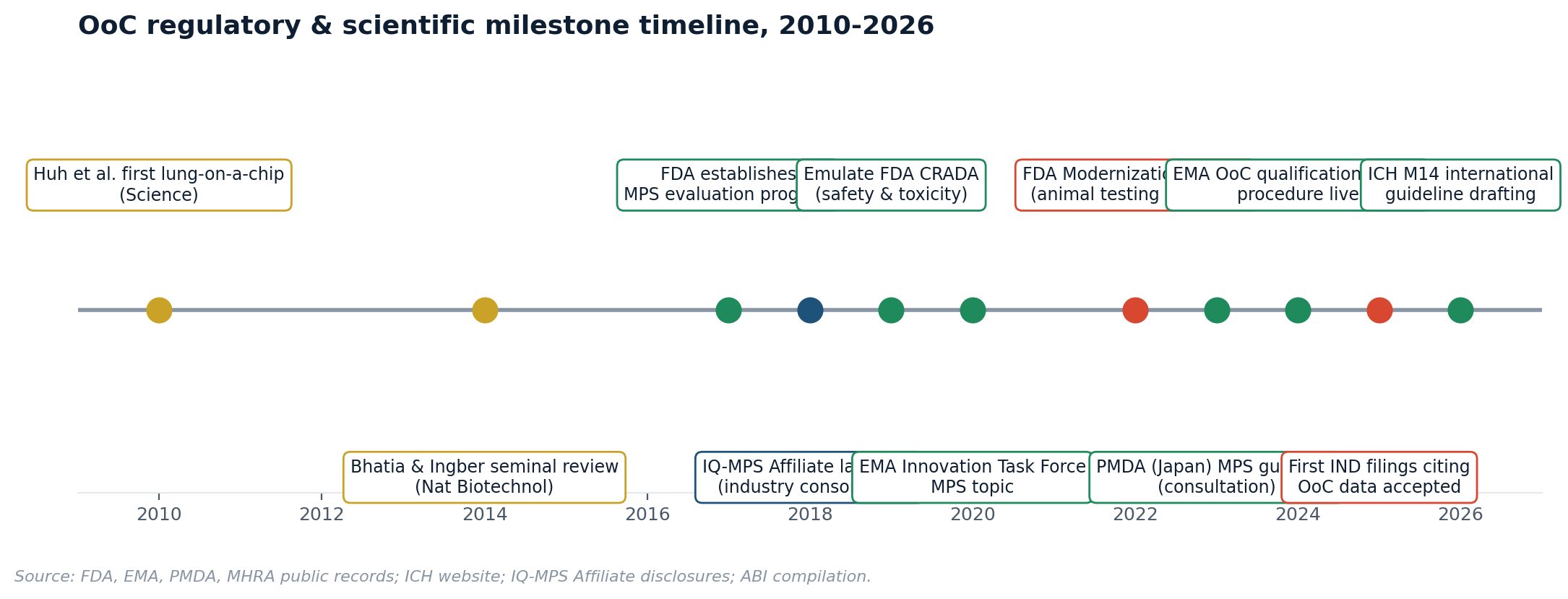
Organ-on-a-chip (OoC) – also called a microphysiological system (MPS) – is a microfluidic cell-culture device that recreates the structure, fluid flow, mechanical forces, and multi-cell interactions of a human tissue or organ on a chip the size of a small computer board. Since the first lung-on-a-chip published by Huh et al. in Science (2010) and the seminal Bhatia & Ingber Nature Biotechnology review (2014), OoC has matured from an academic concept into a commercial preclinical tool used inside every top-20 pharmaceutical company.
The FDA Modernization Act 2.0 (December 2022) is the regulatory inflection. It amended Section 505 of the Food, Drug & Cosmetic Act to remove the explicit mandate for animal testing – opening the door for OoC, organoids, and computer models as legitimate components of an investigational new drug (IND) submission. The first IND filings citing OoC data were accepted by FDA in late 2025.
We size the industry at $210M in 2024, growing to $303M in 2025, $1.2B in 2030, and $3.0B in 2035 under our Base scenario – a 25.8% CAGR. The Accelerated scenario reaches $4.5B in 2035; Constrained $1.8B. Growth is driven principally by expanding chip-consumables volume as installed-platform counts compound inside pharma and academic labs.
The economic case is compelling. Roughly 90% of drugs entering clinical trials fail before approval, with over 60% of those failures driven by toxicity or efficacy problems that animal preclinical models did not predict. The Emulate-AstraZeneca Liver-Chip cross-validation paper (Communications Medicine 2022) identified 87% of clinically-hepatotoxic drugs that had cleared animal studies, and estimated $3B of annual industry value from systematic adoption. Even a 5-10 percentage-point improvement in preclinical predictivity has multi-billion-dollar economic value.
The industry is small but unusually concentrated within named pure-plays. Top-15 listed/visible competitors capture 94% of 2024 TAM – Emulate ($38M), InSphero ($28M, 50% in-scope), MIMETAS ($26M), CN Bio Innovations ($24M), AIM Biotech ($14M), HemoShear ($13M, 60% in-scope), TissUse ($12M), Hesperos ($10M), and ten others. All top-15 are still private. The first OoC IPO (rumored to be Emulate, 2026-27) would be a watershed valuation-discovery event for the entire sector.
For investors, the playbook splits by capital type. Venture and growth-stage capital should focus on Emulate, CN Bio, MIMETAS, Hesperos with diligence on pharma offtake and regulatory qualification. Strategic capital (pharma corporate venture; tools-and-instruments incumbents like Revvity, Bruker, Bio-Techne, Sartorius) should target acquisitions of platform companies at $20-30M+ revenue. Public-equity proxy exposure today is indirect – Revvity (NYSE: RVTY), Bio-Techne (NASDAQ: TECH), Bruker (NASDAQ: BRKR) – until first direct OoC IPOs print.
| Organ chip | What it replicates | Typical readouts | Application focus |
|---|---|---|---|
| Liver-on-a-chip | Hepatocyte + Kupffer + sinusoidal endothelial cells; CYP450 metabolism; bile flow | Albumin/urea; CYP450 activity; ALT/AST; mitochondrial function | DILI; NASH disease modeling; first-pass metabolism; ADME-PK |
| Lung-on-a-chip | Alveolar epithelium + microvascular endothelium with cyclic breathing motion | Barrier integrity (TEER); inflammatory cytokines; particle deposition | Inhaled therapeutics; infection (COVID-19, TB); IPF |
| Kidney-on-a-chip | Proximal-tubule epithelial cells under shear flow | Glucose/albumin reabsorption; biomarker excretion | Nephrotoxicity; drug transport; PKD modeling |
| Gut-on-a-chip | Intestinal epithelium with peristaltic stretch + microbiome co-culture | Barrier integrity; villus formation; microbiome signaling | IBD; microbiome-drug interactions; first-pass GI |
| Brain / BBB-on-a-chip | Neuron + astrocyte + microglia + endothelial across BBB membrane | Neuronal firing; BBB permeability; neuroinflammation | Alzheimer's; Parkinson's; BBB drug penetration |
| Heart/cardiac chip | iPSC-cardiomyocyte sheets with electrical pacing | Contractility; calcium transients; QT (arrhythmia) | Cardiotoxicity (largest tox attrition cause); HCM modeling |
| Skin-on-a-chip | Multilayer keratinocyte + fibroblast + endothelial | Barrier function; wound healing; permeation | Cosmetics safety; drug permeation; psoriasis |
| Vascular / tumor chip | Endothelial-lined microvessels with tumor co-culture | Angiogenesis; drug penetration; immune infiltration | Oncology drug screening; immunotherapy |
| Body-on-a-chip | Fluidically connected multi-organ (4-10 organ chambers) | Inter-organ signaling; systemic PK/PD; multi-organ tox | Systemic drug studies; rare disease; polypharmacy |
| Layer | Standards / methods | Representative vendors | Maturity |
|---|---|---|---|
| L7 Application & data Toxicology, PK/PD, disease models |
Outputs: viability, biomarkers, omics, imaging | Emulate Lab | CN Bio Insights | MIMETAS data services | Emerging |
| L6 Sensing & imaging TEER, optical, electrochem, biosensors |
Standards: ASTM F2603-06 (biocompatibility) | Tissue Dynamics | ThermoFisher | Olympus | Zeiss | Pilot |
| L5 Microfluidic control Pumps, flow sensors, perfusion |
Protocols: ISO 22916; OOC-WG standards (forming) | Fluigent | Elvesys | Dolomite | Microfluidic ChipShop | Commercial |
| L4 Cell / tissue engineering Primary, iPSC-derived, organoids |
Cell sources: iPSC (Cellartis, Fujifilm CDI), primary (Lonza) | Lonza | Fujifilm CDI | Takara Bio | Promocell | Commercial |
| L3 Substrate & device fabrication PDMS, thermoplastics, glass, hydrogel |
Soft lithography + injection molding + 3D printing | Dow (PDMS) | Microfluidic ChipShop | Sigma (Matrigel) | Commercial |
| L2 Materials science Polymers, ECM, bioinks |
PDMS dominant; cyclic-olefin & thermoplastics growing | Dow | Mitsubishi Chemical | BASF | Corning | Commercial |
| L1 Foundational biology Stem cells, organoid biology, tissue engineering |
Academic: Wyss Institute, Hubrecht, MIT, RIKEN | Wyss (Harvard) | Hubrecht (NL) | MIT | RIKEN (JP) | Mature |
| Pipeline stage | OoC use case | Why it adds value | Example users |
|---|---|---|---|
| Target identification | Disease-modeling chips to validate novel targets | Human-relevant biology confirms hypotheses from genomic data | Emulate, MIMETAS at Pfizer, Roche |
| Hit-to-lead screening | High-throughput plate chips (96-well OrganoPlate) | Compares 30-100 compounds in single run; ranks for advancement | MIMETAS OrganoPlate; InSphero Akura Flow |
| Lead optimization | Liver + Cardiac + Kidney toxicity panels | Identifies tox liabilities before significant medicinal chemistry | Emulate Liver-Chip; CN Bio PhysioMimix Liver |
| Preclinical safety | Single-organ chips for IND-supporting safety data | FDA accepts data under Modernization Act 2.0 | Emulate, CN Bio at Roche, AZ, J&J |
| Pharmacokinetics | Multi-organ "body-on-chip" for ADME modeling | Predicts human PK without animal dose-extrapolation | Hesperos Human-on-a-Chip; TissUse HUMIMIC |
| Pharmacodynamics | Disease-specific chips: tumor, BBB | Direct measurement of pharmacological effect on human cells | AIM Biotech tumor chip; Synvivo SynBBB |
| Biomarker discovery | Effluent omics + single-cell sampling | Candidate biomarkers for clinical-trial enrichment | CN Bio + Bio-Techne reagent partnerships |
| Personalized medicine | Patient-derived iPSC chips | Validates in vitro predictivity vs real patient outcomes | Hesperos; Emulate rare-disease consortium |
| Disease area | OoC model | What it enables | Companies / academic groups |
|---|---|---|---|
| Liver disease – NASH/NAFLD | Liver chip with free-fatty-acid-induced steatosis | Tests anti-NASH drugs (selonsertib, obeticholic acid) | CN Bio, InSphero, Roche internal |
| Inflammatory bowel disease (IBD) | Gut chip with cytokine or pathogen-induced damage | Models Crohn's, UC; tests JAK inhibitors, anti-TNF | Emulate (Wyss); Altis Biosystems; MIMETAS |
| Idiopathic pulmonary fibrosis (IPF) | Lung chip with fibroblast co-culture + TGF-β induction | Tests pirfenidone, nintedanib, next-gen IPF therapies | Emulate Lung-Chip; CN Bio |
| Alzheimer's disease | iPSC neuron + astrocyte + microglia chip; BBB variants | Models amyloid plaque, tau; tests anti-amyloid antibodies | AxoSim (Curi Bio); Wyss Institute |
| Cardiac arrhythmia / hypertrophy | iPSC-cardiomyocyte chip with electrical pacing | Models LQTS, HCM; tests gene therapies | Tara Biosystems (Valo); BiomimX uBeat |
| Cancer – solid tumor chips | Vascularized tumor chip + stromal + immune co-culture | Tests checkpoint inhibitors, CAR-T, ADCs | AIM Biotech; HemoShear; Hesperos oncology |
| Cancer – metastasis | Multi-organ chip: tumor + distal organ (lung/liver) | Models metastatic colonization | Synvivo; Charles River Labs (partnership) |
| Sepsis / bacterial infection | Lung or gut chip with bacterial co-culture | Tests antibiotics + host-directed therapies | Emulate; CN Bio; Liverpool MRC CDSS |
| Viral infection (COVID-19, flu, RSV) | Lung or gut chip with viral exposure | Antiviral testing; inflammatory pathway ID | Wyss Institute; Emulate; multiple academic |
| Rare diseases (e.g., Barth, Duchenne) | Patient-derived iPSC chip with disease phenotype | Tests precision therapies on patient's own cells | Hesperos (multiple programs); Wyss |
OoC enables controlled application of physical forces (stretching, shear, compression) that shape cell behavior – impossible in static 2D and uncontrollable in animal models.
Gut-on-chip with microbiome co-culture is the standard tool for studying the microbiome's impact on host physiology, drug metabolism, and immune response.
Chips that recapitulate organ-forming processes (Karzbrun et al., Nature 2021 – neural-tube morphogenesis on chip) provide new experimental tools.
Placenta-, testis-, ovary-on-chip platforms address an area where animal models are particularly poor predictors of human physiology.
| Step | Variable | 2025 | 2030 | 2035 | Source |
|---|---|---|---|---|---|
| 1 | Cumulative OoC platforms installed (units) | 1,450 | 5,200 | 12,500 | ABI bottom-up: Emulate ~400, CN Bio ~150, MIMETAS ~250, TissUse ~100, InSphero ~150, others ~200 end-2024 |
| 2 | Annual chips per platform (units) | 95 | 165 | 245 | Calibrated to Emulate user-base disclosures; rises with throughput improvements |
| 3 | Total chips consumed per year (k units) | 138 | 858 | 3,063 | Computed as row 1 (period avg) × row 2 |
| 4 | Blended chip price ($) | $870 | $580 | $400 | Compression as scale builds; consistent with company list-price trends |
| 5 | Chip consumables revenue ($M) | $120 | $500 | $1,230 | = row 3 × row 4 / 1000 |
| 6 | Instruments revenue ($M) | $75 | $245 | $578 | Platforms × ASP ($120-180k range) |
| 7 | Services revenue ($M) | $62 | $255 | $642 | CRO programs + service contracts; >40% YoY growth recent |
| 8 | Software & data revenue ($M) | $22 | $115 | $335 | Bioinformatics subscriptions + cloud licenses |
| 9 | Biomaterials & reagents ($M) | $24 | $85 | $220 | ECM, hydrogels, media |
| 10 | TOTAL INDUSTRY TAM ($M, Base) | $303 | $1,200 | $3,005 | = sum of 5,6,7,8,9 |
| Rank | Company | Country | In-scope rev ($M) | % of TAM |
|---|---|---|---|---|
| 1 | Emulate Inc. | USA | $38 | 17.3% |
| 2 | InSphero AG | Switzerland | $28 | 12.7% |
| 3 | MIMETAS | Netherlands | $26 | 11.8% |
| 4 | CN Bio Innovations | UK | $24 | 10.9% |
| 5 | AIM Biotech | Singapore | $14 | 6.4% |
| 6 | HemoShear Therapeutics | USA | $13 | 5.9% |
| 7 | TissUse GmbH | Germany | $12 | 5.5% |
| 8 | Hesperos Inc. | USA | $10 | 4.5% |
| 9 | Nortis Inc. | USA | $8 | 3.6% |
| 10 | Tissue Dynamics | Israel | $6 | 2.7% |
| 11 | BiomimX | Italy | $6 | 2.7% |
| 12 | Sphere Fluidics | UK | $6 | 2.7% |
| 13 | Synvivo Inc. | USA | $7 | 3.2% |
| 14 | Altis Biosystems | USA | $4 | 1.8% |
| 15 | Cherry Biotech | France | $5 | 2.3% |
| – | Sum top-15 in-scope | $207 | 94.1% | |
| – | ABI 2024 Industry TAM | $220 | 100% | |
| – | Long-tail / private gap | Academic-program service fees + tools-incumbent MPS-relevant revenue + regional/national MPS programs | $13 (5.9%) | |
| Rank | Company | Country | Structure | In-scope rev ($M) | % of TAM |
|---|---|---|---|---|---|
| 1 | Emulate Inc. | USA | Private | $38 | 17.3% |
| 2 | InSphero AG | Switzerland | Private | $28 | 12.7% |
| 3 | MIMETAS | Netherlands | Private | $26 | 11.8% |
| 4 | CN Bio Innovations | UK | Private | $24 | 10.9% |
| 5 | AIM Biotech | Singapore | Private | $14 | 6.4% |
| 6 | HemoShear Therapeutics | USA | Private | $13 | 5.9% |
| 7 | TissUse GmbH | Germany | Private | $12 | 5.5% |
| 8 | Hesperos Inc. | USA | Private | $10 | 4.5% |
| 9 | Nortis Inc. | USA | Private | $8 | 3.6% |
| 10 | Tissue Dynamics | Israel | Private | $6 | 2.7% |
| 11 | BiomimX | Italy | Private | $6 | 2.7% |
| 12 | Sphere Fluidics | UK | Private | $6 | 2.7% |
| 13 | Synvivo Inc. | USA | Private | $7 | 3.2% |
| 14 | Altis Biosystems | USA | Private | $4 | 1.8% |
| 15 | Cherry Biotech | France | Private | $5 | 2.3% |
Flagship pure-play. Wyss Institute spinout; broadest portfolio (5 organ-chips); deepest pharma user base (18+ top-20 pharma); FDA CRADA on liver safety. IPO filing reportedly drafted Q1 2026.
Best UK exposure. PhysioMimix platform; liver + NASH/NAFLD specialty; FDA collaboration credentials; Charles River Labs US distribution. Strategic-acquisition candidate.
HTS-compatible format. OrganoPlate platform – 96-well plate format for high-throughput screening; GSK strategic investment; growing US arm.
Multi-organ specialist. Cornell/UCF spinout; leading Human-on-a-Chip multi-organ platform (up to 5 organs); rare-disease consortium positioning.
3D InSight microtissue + Akura Flow chip-based platform; strong liver toxicity, NASH, diabetes specialty; Roche / Novartis customers.
Charité Berlin spinout; HUMIMIC multi-organ platform (up to 4 organs); leading Germany pure-play with Bayer, Boehringer customer base.
| Technology | TRL 1 | TRL 2 | TRL 3 | TRL 4 | TRL 5 | TRL 6 | TRL 7 | TRL 8 | TRL 9 |
|---|---|---|---|---|---|---|---|---|---|
| PDMS soft lithography | ● | ||||||||
| iPSC-derived hepatocytes | ● | ||||||||
| Lung-on-a-chip | ● | ||||||||
| Liver-on-a-chip | ● | ||||||||
| Kidney proximal tubule | ● | ||||||||
| Gut + microbiome | ● | ||||||||
| Blood-brain barrier | ● | ||||||||
| Cardiac chip (iPSC-CM) | ● | ||||||||
| Multi-organ "body-on-chip" | ● | ||||||||
| Vascularized tumor chip | ● | ||||||||
| Real-time biosensors | ● | ||||||||
| AI image/biomarker analysis | ● |
Reliable, commercial-scale 4-10-organ chips. Current TRL 5 → 7 by 2028-30. Lead: Hesperos, TissUse, CN Bio commercial; Wyss, MIT, Hubrecht academic.
Faster, more reliable iPSC differentiation. Lead: Fujifilm Cellular Dynamics, Cellartis (Takara Bio), Stanford, MIT, Cambridge, Hubrecht.
Continuous in-chip TEER, O2, pH, metabolites. Lead: Tissue Dynamics; MIT MTL, Imperial College London, ETH Zurich.
ASTM/ISO consortia; IQ-MPS Affiliate harmonization; ICH M14 international guidance expected 2027-28.
ML interpretation of OoC data; Emulate Lab, CN Bio Insights; Valo Health, Recursion adjacent.
| Region | Framework | Direction | Status May 2026 |
|---|---|---|---|
| USA | FDA Modernization Act 2.0 (Dec 2022) | OoC/MPS/organoids/computer models acceptable for IND | First IND filings citing OoC accepted Q4 2025 |
| EU | REACH alternatives + Cosmetics Regulation 1223/2009 | Animal testing banned for cosmetics; alternatives for chemicals | EURL ECVAM validation queue active |
| UK | MHRA innovation pathway + NC3Rs CRACK-IT | Encourage 3Rs (replacement, refinement, reduction) | Multiple MHRA workshops; CN Bio FDA collaboration via UK |
| Japan | PMDA MPS guidance (consultation 2023-24) | Open to MPS data in IND/NDA submissions | AMED-funded MPS program (¥4B+ since 2018) |
| China | NMPA pilot program | Signal-based approach to MPS data | National Centers for Drug Evaluation OoC pilots |
| Multilateral | ICH M14 (in drafting) | Harmonization of MPS guidance across ICH regions | Draft expected 2026-27 |
Approximately 12 million animals used annually in EU scientific research; similar US numbers. OoC + organoids + computer modeling are the only credible substitution path at scale. A 20-30% reduction in animal use across pharma preclinical workflows over a 10-year horizon would be a meaningful ethical and scientific achievement. UK NC3Rs (National Centre for the Replacement, Refinement & Reduction of Animals in Research) leads the framework globally.
Best: Emulate, CN Bio, MIMETAS, Hesperos – Series B-D positions. Diligence weighted to pharma offtake, regulatory qualification, iPSC sourcing.
Worst: sub-scale academic spinouts without pharma reference customers.
Best: pharma corporate venture (Roche, AZ, Pfizer, J&J, MSD, Lilly, Takeda) – equity stakes or acquisitions of $20-30M+ platforms.
Worst: early-stage tech without product-market fit.
Best: Revvity, Bruker, Bio-Techne, Sartorius – acquisitions of platform companies with crossed-revenue threshold.
Worst: pure consumables-only plays without instrument adjacency.
Best: Revvity (NYSE: RVTY), Bio-Techne (TECH), Bruker (BRKR) for indirect exposure.
Direct exposure available: once Emulate IPOs (rumored 2026-27) or MIMETAS/CN Bio is acquired by a public company.
| # | Risk | Likelihood | Evidence | Mitigation |
|---|---|---|---|---|
| 1 | Reproducibility issues persist – inter-lab variability | MED | Multiple pharma users document variability; IQ-MPS Affiliate acknowledges | Standardization via ASTM/ISO; ICH M14 by 2027-28 |
| 2 | Pharma adoption stalls – augment-not-replace | MED | Some pharma users still >50% animal workflows; cultural inertia | FDA acceptances; published economic studies |
| 3 | Organoid technology disrupts at lower cost | MED | Stemcell Technologies, Crown Bioscience growing fast | OoC + organoid hybrid configurations; multi-organ moat |
| 4 | Capital markets close – IPO window stays shut | HIGH | Biotech IPO market weak 2022-25; OoC players burning cash | Strategic acquisition exits; revenue scaling to profitability |
| 5 | Regulatory acceptance slower than expected | MED | FDA qualification process 18-36 months per context | Direct submissions; parallel applications |
| 6 | Top platform company stumbles (Emulate, CN Bio) | MED-HIGH | Concentrated industry – one stumble impacts narrative | Diversified exposure across platforms |
| 7 | iPSC supply or cost shock | LOW-MED | iPSC supplier consolidation; patient-derived cells variable | Multi-supplier sourcing; internal iPSC programs |